Rosewool Insulation Refractory Co.,Ltd.

At the production site of aluminum smelting and processing, the aluminum water ladle, as a key equipment for holding high-temperature aluminum liquid, is subjected to harsh working conditions of high temperature radiation and frequent alternation of cold and heat for a long time. Many companies encounter the same problem in actual production: after using traditional insulation lining for a period of time, it is easy to encounter a series of problems such as board cracking, joint gap heat leakage, insulation layer bonding detachment, and insulation performance degradation.
The temperature of the aluminum water table package shell remains high, with a normal temperature of up to 280 ℃. This not only causes a large amount of heat to be lost in vain, increasing the production energy consumption of the enterprise, but also accelerates the wear and tear of the equipment during long-term high-temperature operation. The temperature rise in the workshop environment also poses safety risks such as burns to frontline workers. How to do a good job in the insulation lining of aluminum water table packaging, achieve effective cooling and long-term insulation, has become a key problem in the equipment operation and maintenance work of many aluminum processing enterprises.
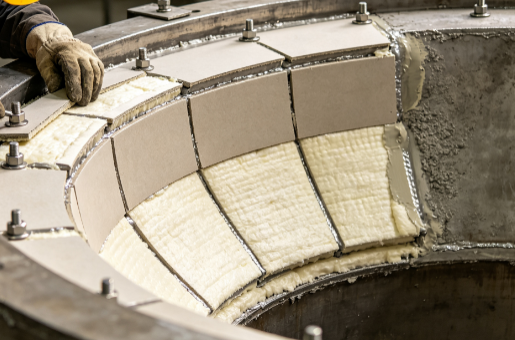
In response to the actual working pain points of aluminum water table bags, Rosewool Insulation Refractory Co.,Ltd. has launched a solution for the transformation of composite insulation lining with nano insulation board and high-temperature resistant sealing insulation coating. The solution adopts rigid nano insulation board as the main insulation layer, combined with flexible high-temperature resistant sealing insulation coating to achieve bonding leveling and gap sealing, creating a seamless integrated composite insulation system, targeting the industry’s stubborn problem of heat leakage in traditional insulation solutions.
The complete renovation plan sets clear performance goals: the normal temperature of the original shell of the Taiwan package is 280 ℃, and after the renovation is completed and stable operation is achieved, the shell cooling should be ≥ 80 ℃. The final temperature of the shell should be controlled at ≤ 200 ℃ to eliminate local hotspots and improve the problem of excessive equipment heat dissipation. By relying on the mutual coordination between the board and the coating, the overall equivalent insulation thickness reaches 15mm; even if the platform package is frequently started and stopped, and the temperature fluctuates repeatedly, the insulation structure can still remain stable and is not prone to detachment, cracking, insulation attenuation, and other phenomena.
To achieve ideal insulation and cooling effects, standardized and refined construction processes are essential.
In the early stage of construction, carry out fine treatment of the base layer, thoroughly clean the steel shell lining of the platform, remove oil stains, floating rust, dust, and old insulation residue debris, polish off protruding burrs, and ensure that the base layer is dry and clean. Small hole defects can be directly filled with Heat Shield Treasure coating, while larger gaps can be filled with high-temperature resistant fiber cotton for leveling, eliminating hollowing and unevenness problems in the base layer and laying a solid foundation for subsequent insulation layer construction.
Subsequently, pre layout and cutting operations of the board will be carried out, combined with the actual size layout of the inner wall of the pallet, prioritizing the use of whole boards and minimizing cutting to reduce the number of gaps from the source. Special cutting tools are used to cut corners and irregular openings to ensure a smooth and edge free cut. At the same time, the principle of staggered tiling is strictly followed to avoid through seams and straight seams, and to cut off channels for direct heat loss.
Entering the laying process, first evenly apply a layer of high-temperature resistant insulation sealing coating on the steel shell base, and at the same time, fully coat the back of the nano insulation board with coating. Thicken the edges of the board appropriately to enhance the bonding and sealing performance. Follow the sequence of laying from bottom to top, flat first and back corners, compact the board and discharge the interlayer air to avoid hollowing and delamination; The splicing gap of the board should be controlled within ≤ 2mm, and then reinforced with 310S stainless steel anchors. The distance between the vertical wall anchors should not exceed 300mm, and the distance between the top positions should not exceed 200mm to ensure that the insulation layer is firmly fixed.
Fully sealed gaps are the core component of the entire process for preventing heat leakage. All panel joints, cutting joints, corner gaps, and anchor holes shall be filled and sealed with high-temperature resistant sealing and insulation coating; When encountering wide gaps, first embed high-temperature resistant fiber cotton and then apply coating and compact it, leaving no breathable or heat permeable gaps, truly achieving full position sealing.
After the completion of the project, multiple inspections are required to verify the quality of the renovation. Visually, the insulation lining surface is smooth and intact, without damage, hollowing or cracking, the gaps are tightly sealed, and the anchoring components are firm and regular; During performance testing, the package is filled with aluminum water and runs stably for 2 hours. Infrared thermometers are used to collect the temperature of the outer shell at multiple points. If the cooling range and final temperature indicators are met and there are no local high temperature hotspots, it is considered qualified. Concealed processes such as layout, anchoring, coating, and gap sealing should be checked and recorded simultaneously, and construction image data should be retained to ensure quality traceability.
Core Results of Nano Thermal Insulation Board+High Temperature Resistant Coating Solution
This composite system of rigid board and flexible sealing coating not only utilizes the core insulation advantages of ultra-low thermal conductivity and high temperature resistance of aluminum foil nano insulation board, but also relies on high temperature resistant sealing coating to tightly seal all gap channels. With an effective insulation thickness of 15mm, the design goal of achieving a stable cooling of 80 ℃ is achieved. This not only reduces heat dissipation losses, but also optimizes the workshop working environment, extends the service life of the equipment, and fully adapts to the long-term high-temperature alternating production conditions of aluminum water platform packaging.
Rosewool Insulation Refractory Co.,Ltd. Core Product Strength
Aluminum foil nano insulation board (main insulation layer)
The maximum safe operating temperature of this product is 950 ℃, with a density of 300 ± 10% kg/m ³. Under 850 ℃ conditions, the linear shrinkage rate after 3 hours is ≤ 2%; At 800 ℃, the thermal conductivity is ≤ 0.038W/m · K, indicating excellent thermal insulation performance. The board has good rigidity, easy cutting and processing, and can achieve considerable insulation and cooling effects with thin thickness. Inorganic materials are safe and environmentally friendly, suitable for high-temperature production environments in metallurgical aluminum processing.
High temperature resistant sealing and insulation coating (specifically for adhesive sealing)
The maximum operating temperature can reach 1000 ℃, the dry density is 270kg/m ³, the compressive strength is ≥ 0.65Mpa, the linear shrinkage rate after 3 hours at 950 ℃ is ≤ 2%, and the thermal conductivity at 300 ℃ is ≤ 0.087W/m · K. It integrates multiple functions such as bonding, gap sealing, and auxiliary insulation. The flexible coating can buffer the deformation stress caused by thermal expansion and contraction, effectively preventing cracking and delamination; Suitable for various construction methods such as painting and filling joints, it can be used for steel shell base, board back, and various types of gaps and holes.
As a professional manufacturer of high-temperature refractory insulation materials, Rosewool Insulation Refractory Co.,Ltd. can provide one-stop services for aluminum smelting and processing enterprises, including material supply, customized solutions, and construction technical guidance. In addition to the aluminum water table package, customized composite insulation solutions can be provided for high-temperature thermal equipment such as aluminum water transfer packages, melting furnaces, and insulation furnaces, helping enterprises achieve dual benefits of energy conservation, cost reduction, and safe production.